Interactive streaming means viewers influence what happens on stream instead of only watching it. The influence can be as small as a poll and as big as a keyboard input landing in your game. This guide defines the five levels of Twitch interactivity, shows what each level needs and helps you decide how far your channel should go.
You do not need every level. A focused channel with two working interaction types beats a cluttered one with ten. Build one level, run it for a few streams, then decide whether the next one fits your content.
What is interactive streaming?
A stream is interactive when a viewer action produces a visible reaction on stream within seconds. Three ingredients have to be present:
- A trigger viewers understand. Chat commands, Channel Points rewards, Extension panels or enabled actions.
- A visible or audible result. A poll outcome, a sound, a spoken message, an on-screen effect or a real input in the game.
- Boundaries the streamer controls. Cooldowns, limits, moderation and an emergency stop.
Interaction formats give viewers a reason to stay and participate rather than lurk. Treat that as a format decision, not a growth guarantee: no interaction tool can promise more viewers or longer watch time. What it reliably changes is the number of shared moments that are worth clipping.
The five levels of Twitch interactivity
| Level | Interaction | What it needs |
|---|---|---|
| 1 | Chat, polls and predictions | Nothing beyond Twitch |
| 2 | Channel Points rewards | Twitch monetization onboarding |
| 3 | Sounds and TTS | A tool such as ControlPlay, no extra hardware |
| 4 | On-screen effects | A tool and a tested capture setup |
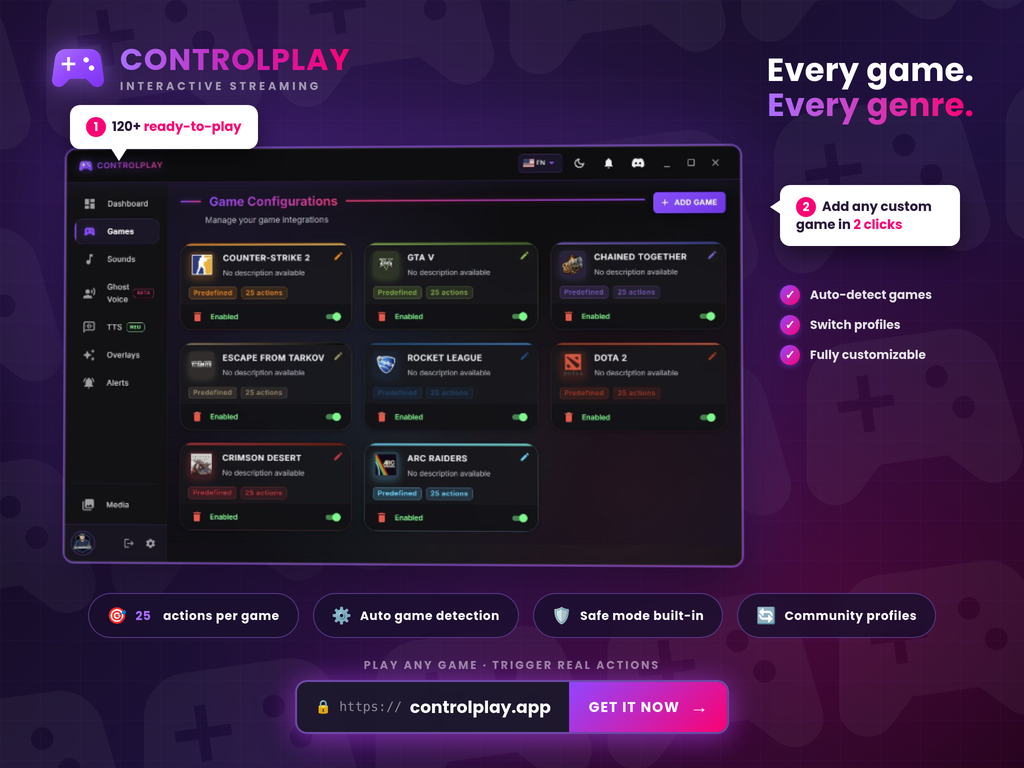
| 5 | Real in-game actions | ControlPlay with its USB device |
The levels stack. A channel running level 5 still uses chat, rewards and sounds; the higher levels just add sharper moments on top.
Level 1: chat, polls and predictions
Start here even if you plan to go much further. Ask direct questions, run polls for the next map or loadout and use predictions during risky sections. These formats train your community to expect that their input matters, which every later level builds on. They also work on any channel, with no eligibility requirements or tools.
Level 2: Channel Points rewards
Channel Points are a free engagement currency: viewers collect channel-specific points by watching and participating, and the points have no monetary value and create no revenue. Well-designed rewards are the first structured interaction most channels get. The Channel Points ideas guide covers reward design, cost ladders and the ControlPlay conversion that turns redemptions into Coins for interactive actions.
Level 3: sounds and TTS
Audio is the first level where a viewer action changes what everyone hears. A viewer-controlled soundboard lets your community fire approved clips at the right moment; TTS turns a written message into a spoken one. Both run through the ControlPlay Windows client without extra hardware. Configure Coin amounts, cooldowns and moderation before the first live test. The Twitch sound alerts guide and the Twitch TTS setup guide cover setup, audio routing and troubleshooting in detail.
Level 4: on-screen effects
Overlay-style effects put the viewer's action on the screen itself: confetti after a milestone, a short filter, a jumpscare during a horror session. They are more spectacular than audio but still leave your inputs untouched. Test every effect with your capture setup before viewers can trigger it, and keep such effects disabled in ranked or tournament play when the title's rules restrict what may run on top of the game.
Level 5: real in-game actions
The highest level ends inside the game: a viewer triggers an action you configured, and the ControlPlay USB device sends the mapped keyboard or mouse input. Someone jumps at the worst moment, drops your weapon or spins the camera. Viewers only ever choose from actions you created, enabled and limited; they never get remote access to your PC. This level needs honest compatibility testing per game and conservative cooldowns. The viewer game control guide covers the full setup, and the Crowd Control comparison explains when game-specific effect packs fit better than input-based actions.
Keep the three participation routes separate
Interactive setups touch three systems that must never be mixed up when you explain them to your community:
| Option | Role in an interactive stream |
|---|---|
| Coins | Non-transferable ControlPlay action credits with no cash value. Viewers trigger enabled actions with available Coins. |
| Channel Points | Up to three optional beta rewards convert redeemed, channel-specific points into Coins at the rate you configure. This route creates no revenue and no 80/20 allocation. |
| Bits | Bits in Extensions remain a separate Twitch feature for eligible Affiliate and Partner channels, with an explicit confirmation step for each permitted interaction. |
The Twitch monetization guide explains the Bits in Extensions model, eligibility and reporting in detail. Keep that discussion separate from your interaction design: viewers should understand what a reward does before they ever think about how the systems behind it work.
Design rules that keep interaction fun
The failure mode of interactive streaming is not too little chaos but unmanaged chaos. Five rules prevent most problems:
- Name the outcome. "Drop current weapon" and "Play the airhorn" need no explanation. Clever names do.
- Cooldowns before variety. One well-limited action is better than five that can stack into a wall of noise.
- Match intensity to content. A jumpscare belongs in a horror session, not in a calm story segment. Disable what does not fit today's stream.
- Moderate before playback. Word filters and review queues for TTS, reviewed names for naming rewards, a moderator who knows the controls.
- Keep an emergency stop ready. Pauses, DND windows and a stop switch protect sensitive moments. A cooldown is not a safety switch.
Re-test your setup after every game update or keybind change. Interaction that silently fails teaches viewers to stop trying.
Common mistakes when adding interactivity
| Mistake | Better approach |
|---|---|
| Launching ten actions at once | Start with three, watch what gets used for two weeks |
| Copying another channel's menu | Match actions to your game and your community's humor |
| Prices nobody can reach | Calibrate against what an average viewer collects in one session |
| No viewer-side test | Trigger every action from a viewer account before going live |
| Ignoring game rules | Check publisher, server and tournament rules before enabling game actions |
| Set up once, never reviewed | Retire ignored actions and rotate in new ones per game |
Build your first interactive setup
- Pick your level. Match it to your content, your eligibility and your tolerance for disruption.
- Create a ControlPlay account. Register, connect Twitch, install the Windows client and activate the Twitch Extension for levels 3 to 5.
- Configure three actions. One sound, one TTS or effect option, one game action if you use the USB device. Set Coin amounts, cooldowns and limits.
- Test from the viewer side. Confirm visibility, audio levels and the complete trigger-to-result path in OBS.
- Go live and measure. Watch which actions get used, which get ignored and which create clips. Adjust one thing at a time.
Interactive streaming is a format you grow into, not a switch you flip. Start at the level your channel can support today and let your community pull you toward the next one.