Lists of games with Twitch integration usually stop at the titles that ship a chat connection out of the box. That leaves the more common question open: what do you do when the game you actually stream has no integration at all? This guide sorts the three ways a game becomes interactive on Twitch and shows how to make viewer interaction work with almost any PC title.
The three ways a game gets Twitch integration
| Approach | How it works | Fits when |
|---|---|---|
| Native integration | The game itself connects to your channel and reacts to chat or votes | Your exact title ships and still maintains the feature |
| Mods and effect packs | A per-game mod or pack changes values inside the game | A maintained pack exists for your exact game and version |
| Input-level actions | Viewers trigger predefined keyboard or mouse inputs that reach the game like a normal keypress | Any PC game you can play with keyboard and mouse |
Native integrations are the deepest but the rarest, and studios sometimes retire them. Effect packs are game-aware but bound to a supported-games list. Input-level actions are the broadest option: they do not read or modify the game, so they work wherever a configured keypress works.
Games with native Twitch integration
A handful of titles were built around the audience or added an official chat connection. Well-known examples include:
- Marbles on Stream. Viewers join races directly from chat; the game exists for streaming.
- Choice Chamber. Chat votes shape the level, enemies and power-ups in real time.
- Jackbox Party Packs. The audience joins rounds and votes through a room code, which makes them a streaming staple even without a direct Twitch API connection.
- Move or Die. An official integration lets chat vote on mutators and interfere with rounds.
- Streets of Rogue. Chat can vote and trigger events through the built-in integration.
- Party Hard. Viewers vote on events that help or sabotage the run.
- Tricky Towers. Chat votes influence matches through the official integration.
- Clone Drone in the Danger Zone. Spectating chat can name robots and vote in the arena.
Treat any such list as a snapshot. Integrations break after game updates, get retired or require extra setup, so check the store page and patch notes for the current status before you plan a stream format around one.
If your game has a maintained native integration, use it: nothing else reacts to your community with the same game-specific depth. The gap is that a few dozen titles cannot cover what most streamers actually play.
Games covered by mods and effect packs
Per-game effect packs, the model behind tools like Crowd Control, extend interactivity to a few hundred supported titles. A pack developed for one game can change values inside it: spawn an enemy, alter gravity, rename an item. That depth is the strength of the model, and its limit is the list itself: no pack, no interaction, and an outdated pack can lag behind the current game version.
The Crowd Control comparison covers when a game-specific pack is the better choice and when it is not. The short version: if your exact game has a maintained pack with the effects you want, packs are hard to beat. If not, you need an approach that does not depend on per-game development.
Add viewer interaction to any game with input-level actions
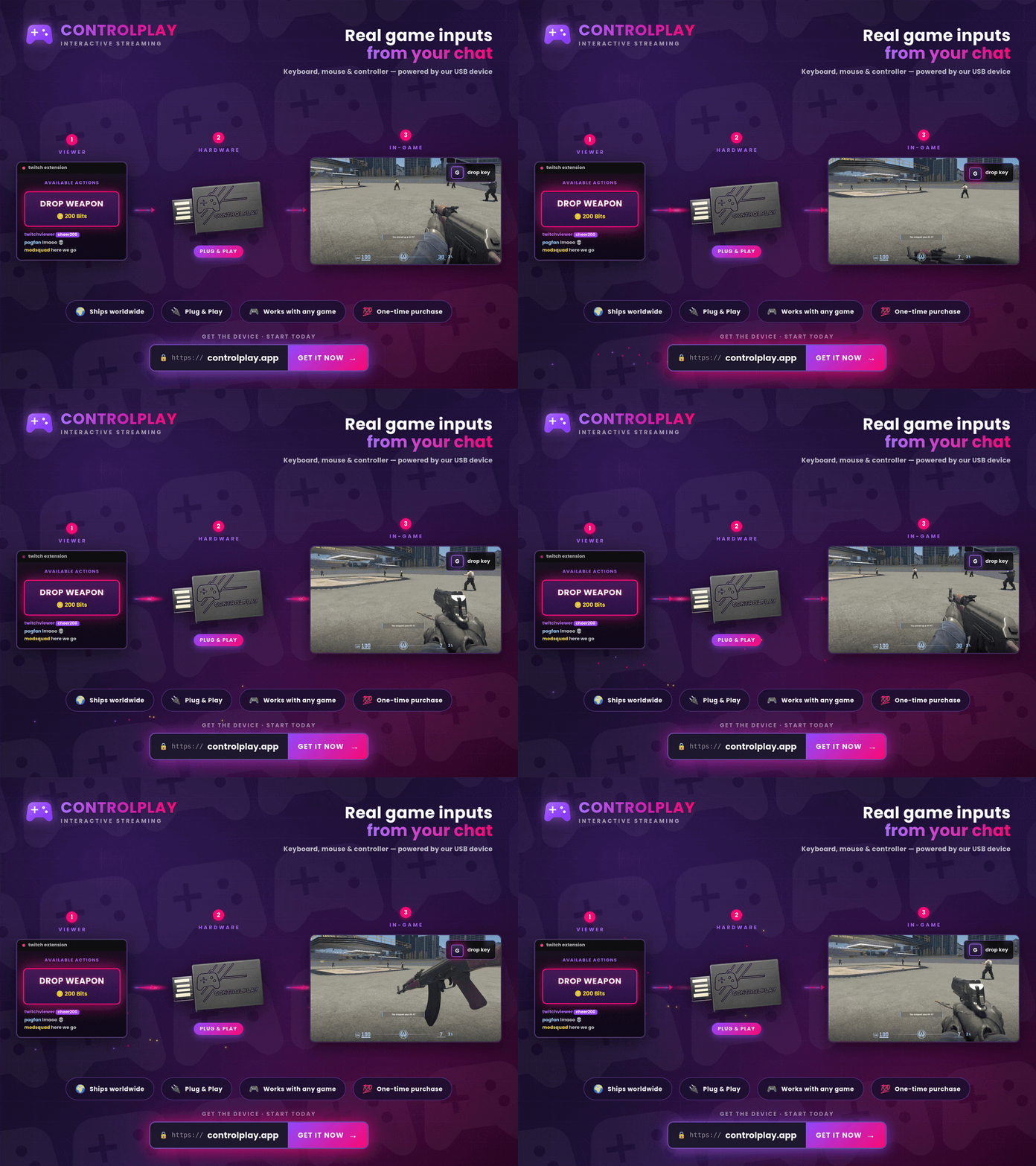
ControlPlay takes the third approach. You define actions as keyboard or mouse inputs, viewers trigger them through the Twitch Extension with available Coins, and the ControlPlay USB device sends the mapped input to your PC like a physical keypress. The game does not need an integration, a mod or a pack; it only needs to accept normal keyboard and mouse input.
That single property changes the coverage question. Instead of asking "is my game on the list?", you ask "which of my keybinds would be fun in viewer hands?". A jump at the wrong moment, a dropped weapon, an item switch or a held sprint works in a niche indie game as well as in a major release. ControlPlay ships preconfigured profiles for many popular PC titles as starting points, plus a custom macro editor for everything else.
Two honest limits apply. First, input-level actions cannot do what only game code can do: they press keys, they do not spawn enemies or change gravity. Second, standard input does not override a game's rules. Check the publisher's terms and the server or tournament rules, avoid ranked and competitive modes unless viewer interaction is clearly allowed, and re-test actions after every game update. The viewer game control guide covers setup, testing and safety limits in detail.
Which genres tolerate viewer interaction best
Interaction only helps a stream when it fits the game. A rough map by genre:
| Genre | What works | What to watch |
|---|---|---|
| Co-op horror | Jumpscare sounds, TTS whispers, movement actions at tense moments | Strict cooldowns so scares stay scarce |
| Sandbox and survival | Item drops, camera spins, building interruptions | Disable actions during delicate builds |
| Simulators | Sounds, TTS commentary, horn or wiper style actions | Long sessions need rotating action menus |
| Party and physics games | Almost everything; chaos is the genre | Per-user limits so one viewer cannot dominate |
| Story-driven games | TTS reactions and ambient sounds | Pause interactions during cutscenes and emotional beats |
| Competitive titles | Sounds and TTS between matches at most | Keep game actions off; respect ranked and tournament rules |
Titles that currently trend in co-op streams, such as Lethal Company, PEAK, R.E.P.O. or Chained Together, sit in the sweet spot: forgiving rules, shared failure as comedy and moments that clip well.
Sounds and TTS work in every game
Game actions are the deepest layer, but they are not the only one. Viewer-triggered sound alerts and TTS run through the ControlPlay Windows client and never touch the game's inputs, so they work in every title, including the competitive ones where game actions are off the table. The Twitch sound alerts guide and the Twitch TTS setup guide cover both setups.
Keep the participation routes separate when you explain any of this to your community:
| Option | Role in an interactive game setup |
|---|---|
| Coins | Non-transferable ControlPlay action credits with no cash value. Viewers trigger enabled actions with available Coins. |
| Channel Points | Up to three optional beta rewards convert redeemed, channel-specific points into Coins at the rate you configure. This route creates no revenue and no 80/20 allocation. |
| Bits | Bits in Extensions remain a separate Twitch feature for eligible Affiliate and Partner channels. |
The Twitch monetization guide explains that separate model, and the Channel Points ideas guide shows how converted redemptions become interactive rewards.
Test a game for viewer interaction before you go live
- Check the rules. Publisher terms, server rules and tournament policies come first. A supported profile is not a permission slip.
- Map one harmless action. Match it to your current keybinds and give it a name that states the outcome.
- Test offline. Trigger the action in a safe area, confirm the input and its release, then repeat through the Extension with a trusted viewer.
- Set limits. Coin amounts, cooldowns and per-user limits before the first live session, with the emergency stop ready.
- Re-test after updates. Patches change keybinds, input handling and rules. A quick test before each session prevents silent failures.
If the game you stream never appears on any integration list, that is exactly the case input-level actions were built for. Create a ControlPlay account, start with one action in a safe title and let your community surprise you.